

In one day, tomorrow, June 19, 2025, you are going to hear the partial story of how black people finally realized their emancipation shortly after the Civil War back in 1865.
 It is called “Juneteenth,” and was celebrated by very few people until Joe Biden made it a National Holiday back in 2021.
The reason why hardly anyone noticed its significance is because it was not that significant, and it took a dementia-ridden, old man, who barely understood where he was at or what he was doing to sign into law something that really had nothing to do with history and everything to do with pushing an agenda antithetical to black emancipation.
More on that tomorrow.
In this blog article I want to point out that there is nothing inherently wrong about “slavery” or servitude, so long as Jesus Christ is at the center of it, and that unless he is at the center, then all the clamoring about equality, oppression, and reconstruction are rooted in anti-christian rhetoric that will eventually leave everyone in chains, regardless of a person’s skin color, if left to run its full course.
First of all, the concept of slavery is all over the Bible, using various Hebrew and Greek words 1,200+ times (200+ in the New Testament alone) to describe it.
Slaves were used to get things done pretty much in the same manner as things get done today, except today we call those persons employees.
Not all slaves were treated kindly or equally, but many of them were, so long as the biblical mandates laid out in both the Old and New Testaments were followed.
Of course, in the secular world, the slave owners did not necessarily follow such mandates, and that caused much hardship for those sold into slavery.
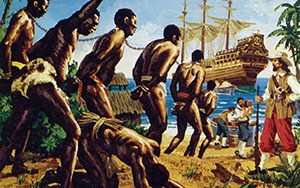
Credit to telegraph.co.uk
Today, when the subject of slavery is raised, images of only certain races of people come to mind, as the slaves are forced into hard labor breaking rocks, plowing fields, or picking cotton.
In some cases, the females were subject to rape and torture by their male taskmasters, thereby causing most people to cringe of ever thinking about owning a slave or attempting to free those who might still be slaves in a foreign land.
That said, the Bible does not shy away from the usefulness of slavery and is why one does not even find Jesus, in Gospels, rebuking slave owners.
Instead, we have him saying things like, “A disciple is not above his teacher, nor a slave above his master” (Matt. 10:24) and “Therefore the kingdom of heaven may be compared to a king who wished to settle accounts with his slaves” (Matt. 18:23).
But, the apostle Paul probably gives the greatest instruction on the subject of slavery, which is something you will not hear from anyone these days, who seem more hellbent on putting people into slavery under the guises of revolution and reconstruction than they are in setting anyone free.
Paul wrote,
Bondservants [“slaves” – Gr. δούλοις], obey in everything those who are your earthly masters, not by way of eye-service, as people-pleasers, but with sincerity of heart, fearing the Lord. Masters, treat your slaves [Gr. δούλοις] justly and fairly, knowing that you also have a Master in heaven (Col. 3:22-4:1).
Prior to those stunning statements that surely run chills up the spins of every Liberal-loving, Socialist-sycophant in America today who attempts to brainwash, and in many cases has succeeded, the black community (and anyone else stupid enough to listen), Paul lists several imperatives that precede them, going all the way back to Jesus Christ as the source of his comments.
 For example, in Colossians 3:1, “If then you have been raised with Christ, seek the things that are above, where Christ is, seated at the right hand of God.”
In 3:2, “Set your minds on the things that are above, not on things that are on earth.”
In 3:5, “Put to death therefore what is earthly in you: sexual immorality, impurity, passion, evil desire, and covetousness, which is idolatry.”
In 3:8, “But now you must put them all away: anger, wrath, malice, slander, and obscene talk from your mouth.”
In 3:12, “Put on then, as God’s chosen ones, holy and beloved, compassionate hearts, kindness, humility, meekness, and patience.”
And last, but least, 3:16, “Let the word of Christ dwell in you richly…”
Then we come to Colossians 3:22-4:1, cited above, regarding slavery.
Again, there is nothing inherently wrong about slavery, as everyone is a “slave” or servant to someone.
What makes slavery wrong, abusive, and inhumane in some cases, is when Christ has been divorced from the conversation, and both slaves and slave-owners start doing their own things that make conditions both unfair and unjust.
It is something that today’s loud-mouth grifters do not want to discuss, but want to have it their way, which tends to make everything worse, as more and more people suffer in slavery of a different kind they were duped into believing would solve all their miseries.