Most recently I have been in discussions with members of the Roman Catholic Church in an effort to try and convince them that Roman Catholicism is not what it claims to be, namely, the “Mother” of the faithful 1
According to them, the “Church” teaches nothing that is contrary to “God’s word.”
Since I have wanted to explore these claims and doctrines of Roman Catholicism for quite some time, given that over a billion people subscribe to its guidance, I thought I would begin by asking, “Okay. So, where in the Bible (any Bible) is the Office of the Pope to be found”?
After all, is not the Bible “God’s word”?
If Roman Catholicism teaches “nothing that is contrary” to it, then, surely that lofty office should appear in there somewhere, right?
Wrong. The Office of the Pope appears nowhere in any Bible, which includes those versions of the Bible sanctioned by the Roman Catholic hierarchy for parishioner’s consumption. 2
Yet, the counter to that conclusion is that the concept of the Pope appears in the Bible, much like the concepts of the “Trinity,” “original sin,” and the “virgin birth” do.
Really?
Yes, really.
It’s just that some manipulation has to take place to align it with the term “father,” and presto! It’s in the Bible!
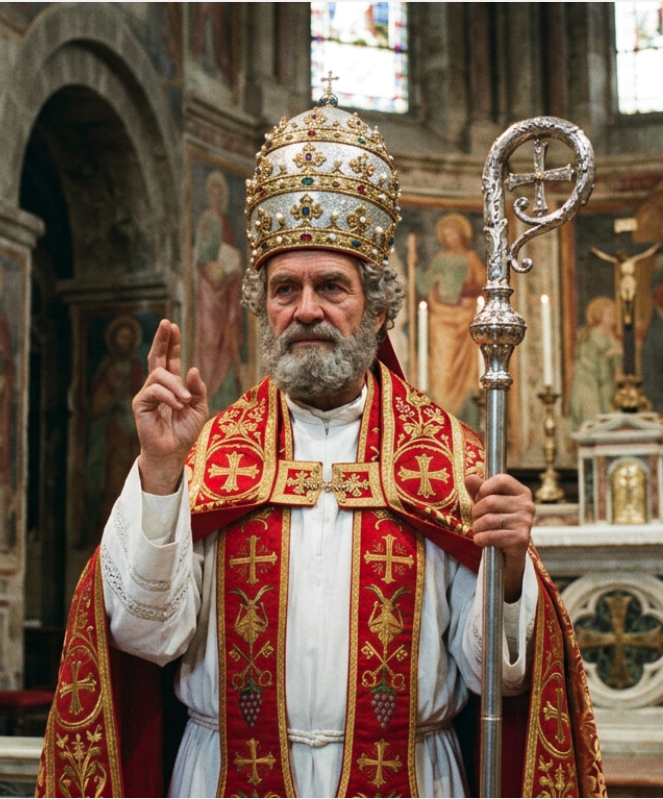
In fact, the word “Pope” is a Latin term (páppas), from which we get papa, and means “father.”
The problem with the counter-argument is that it confuses an analogy or metaphor with an office or position that is clearly stated in the Bible.
For example, in 1 Corinthians 4:15, a favorite reference among Roman Catholics who try to make the case that “Pope” means “father,” the Apostle Paul told the Christians at Corinth, “For though you have countless guides in Christ, you do not have many fathers. For I became your father in Christ Jesus through the gospel.”
Is Paul talking about accepting an official position, not unlike an apostle, evangelist, pastor, or teacher (cf. 1 Cor. 12:28; Eph. 4:11), or is he talking about serving as a “guide” himself?
Contextually, he is referring to himself as a guide, not that he holds and office that they should recognize, adore, and bow down to kiss any rings he might be wearing on his hands.
Paul makes a similar appeal in Philemon 10.
Roman Catholics do the same with Peter’s comment at 1 Peter 5:13: “She who is at Babylon, who is likewise chosen, sends you greetings, and so does Mark, my son.”
But, once again, is Peter talking about an office in relation to John-Mark, as his “son,” or is he talking about a traveling companion in the faith, whereby Peter is humbly playing his part as a role model and servant?
From what I have learned, thus far, Roman Catholicism, like all Christian cults and caricatures, has taken a handful of Bible verses and created a monument that it expects everyone to bow before.
The “concept” or idea of the Pope has zero biblical support, even when the attempt to equate it with terms like “father” become the main argument.
Instead of obeying Jesus’ command to “call no man your father on earth, for you have one Father, who is in heaven” (Matt. 23:9), the Roman Catholics have taken an obscure term (Lat. páppas), first referenced some two or three hundred years after the birth of Jesus 3, and then equated it with another term (Gr. patēr or “father”), and created an office or position alongside other offices and positions found in the Bible (apostle, evangelists, pastors, and teachers).
To make matters worse, they falsely assume that Peter was the first Pope, when nowhere in the Bible, nor anywhere else in early Christian history (except in unhallowed halls Roman Catholicism some three centuries removed from Pentecost), was he recognized as such, much less did anyone call him “father.”
More to come.